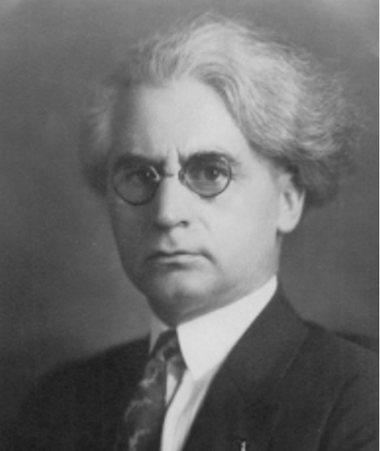
Shahan Natalie
1884–1983 · Writer, editor, and the mastermind of Operation Nemesis
Shahan Natalie is the source of the principle that still defines Global Peace International: that those who orchestrate crimes against a people must never outlive accountability. He is also the grandfather of GPI's founder.
He was born Hagop Der Hagopian in December 1884, in the village of Husenik, in the Kharberd province of Western Armenia — the only son of a seven-member family, with four sisters. At the age of eleven, during the Hamidian massacres of 1894–1896, his father, his uncle, and numerous relatives were among the more than 300,000 Armenians murdered. Separated from his family in the slaughter, the boy survived only because an older Armenian neighbor hid him for three days on the plantation of the Turk he worked for. He emerged to find his mother weeping over his father's body; together they buried him under a walnut tree. “The living began to bury the dead,” he later wrote. The scene never left him.
After a year at Kharberd's Euphrates College and a stay at the St. James Orphanage in Constantinople, he arranged his own path forward, finding an Armenian rug merchant in New York named Mahdesian, who legally adopted him and sponsored his education at the renowned Berberian Academy, where he studied until 1900. In honor of his teacher, the philosopher and pedagogue Reteos Berberian, he took the name “Shahan” — the name of Reteos's own son. He kept the surname Natalie for reasons still unknown, thought to derive from the Latin natalis, “native-born.”
In 1904, in Kharberd, he joined the Armenian Revolutionary Federation, in whose ranks he would serve for a quarter century. That same year he immigrated to the United States — traveling under his adopted father's surname, Mahdesian — and worked three years in a shoe factory; he returned home in 1908, was driven back into exile by the 1909 Cilicia massacres, and from 1910 to 1912 studied literature, philosophy, and theater at Boston University. From 1912 to 1915 he served as editor-in-chief of the ARF's Hairenik monthly and sat on the party's United States Central Committee. When news of the Genocide reached him, the orphaned boy made his vow: not to leave the perpetrators unpunished, even if the world chose to ignore their crime.
Operation Nemesis
After the war, an Ottoman military tribunal in Constantinople condemned to death the principal architects of the Genocide, who had been extradited to the British-held island of Malta. The British placed no value on the sentences and quietly released them. When it became clear the death sentences would never be carried out — protected by powerful interests, and even courted by figures in the newly independent Armenian government — Shahan Natalie, then president of the Armenian Diaspora Writers' Union, became the driving force behind carrying them out.
As recounted in his own memoir, Memoirs of a Stranger, he was the “primary motivator, planner, and spirit” of the campaign known as Operation Nemesis, with Grigor Merjanov as his principal collaborator. The executions were carried out under official orders from the Armenian Ambassador to the United States, Dr. Garegin Pastermadjian — enforcing both the Ottoman court's death sentences and the laws of war recognized under the 1907 Hague Convention. A “black list” of roughly 200 names was drawn up. The men on it were not merely fugitives; they had regrouped and were planning to finish what they had begun, with Artsakh and then Armenia as their next targets.
His “Number One” was Talaat Pasha, and the mission of felling him was entrusted to Soghomon Tehlirian. Shahan Natalie's instruction was deliberate: “You blow up the skull of the Number One nation-murderer and you don't try to flee. You stand there, your foot on the corpse, and surrender to the police.” The purpose was to turn Tehlirian's trial into the trial of the Genocide itself — which, in Berlin in 1921, it became. Under the most unfavorable conditions, the squad succeeded. Had it failed, Armenia might well have been wiped from the map.
He believed that justice deferred to the convenience of the powerful is not justice at all — and that someone, somewhere, must be willing to see it through.
The cost of conviction
For refusing to reconcile with the perpetrators, Shahan Natalie paid a lasting price within his own movement. As the ARF leadership drifted toward accommodation with Turkey, he became the voice of the “Freedom Fight” opposition — and in the party's 1929 “cleansing campaign” he was the first Bureau member removed. He spent his later years in community work with the Armenian General Benevolent Union, revisited a Sovietized Armenia in 1958, and lived largely in seclusion from the 1960s on. He wrote under several names — among them Nemesis, the Greek goddess of just retribution — and left a substantial literary legacy, including his essay The Turks and Us.
He died on the morning of April 19, 1983, in his home in Watertown, Massachusetts, at the age of 98. His funeral was held at the St. James Armenian Church, officiated by Archbishop Torkom Manoogian, and he was laid to rest in Mount Auburn Cemetery.
That conviction is the inheritance Global Peace International was built to carry forward. Where Natalie's generation was left with no recourse but to act alone, ours has the tools to act together, in the open, through law, documentation, and sustained public pressure. The mission is the same. The method has grown up.
Read the book: Memoirs of a Stranger.
Read about our founder and CEO, Ara Khachig Manoogian, Shahan Natalie's grandson.