
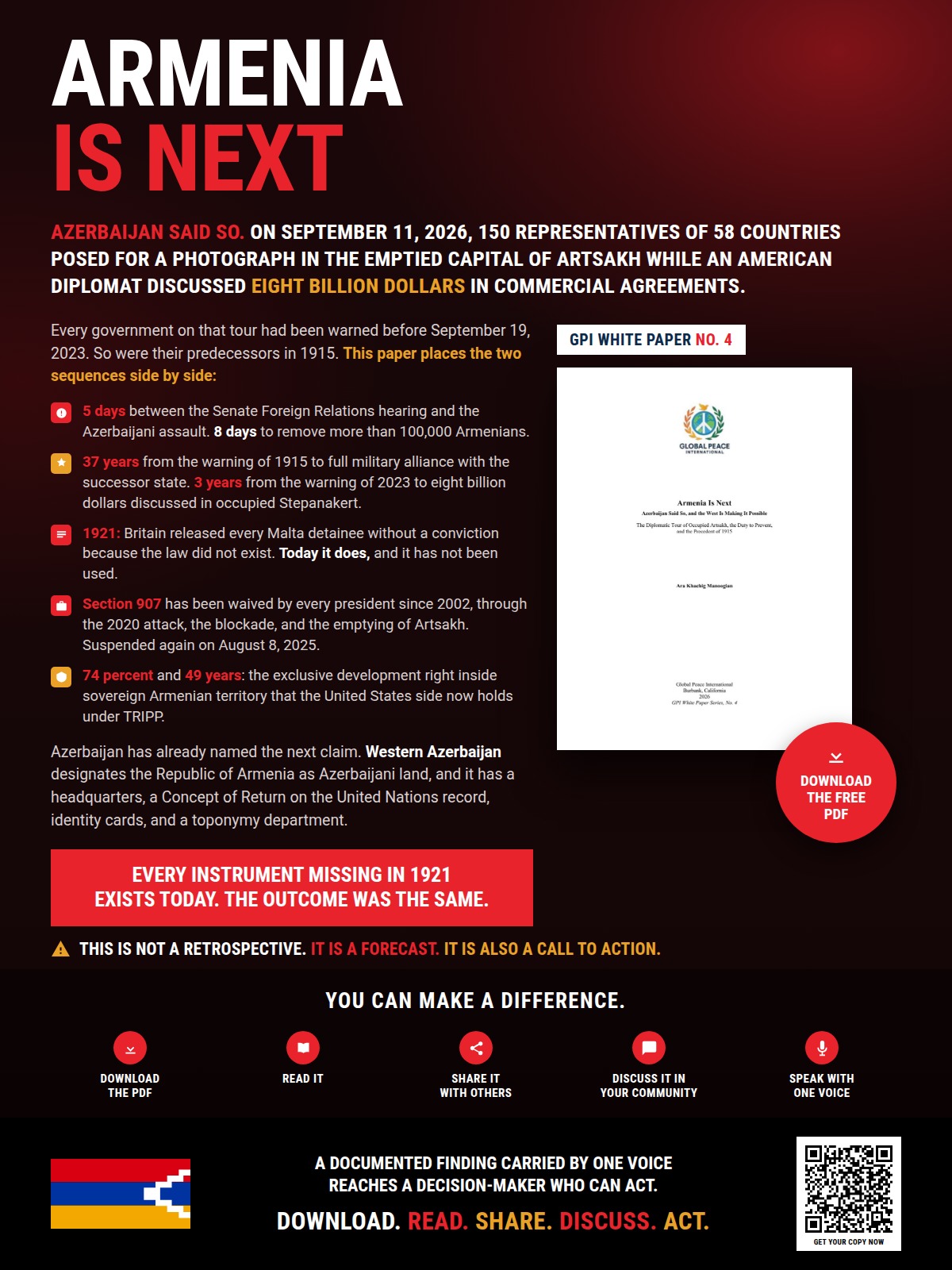
On September 11 and 12, 2026, the government of Azerbaijan drove roughly 150 representatives of 58 countries and nine international organizations into occupied Artsakh and photographed them in front of a Victory Arch in the emptied capital of Stepanakert. The United States chargé d’affaires used the occasion to discuss more than eight billion dollars in commercial agreements, American participation in Azerbaijan’s defense exhibition, and the continued suspension of Section 907. Three years earlier, the people who lived in that city were removed from it in eight days.
Global Peace International’s fourth white paper, Armenia Is Next: Azerbaijan Said So, and the West Is Making It Possible, documents what the governments represented on that tour knew before September 19, 2023, and what they have done since. Its central finding is that their conduct reproduces, in compressed form, the conduct of the same governments after 1915: forewarning, failure to prevent, failure to punish, and then economic and military normalization with the perpetrator state.
One of its recommendations deserves to be stated on its own, because it concerns a decision being taken now rather than one taken in 2023. The Trump Route for International Peace and Prosperity should be placed on indefinite hold.
What the arrangement actually is
TRIPP is no longer a concept. On August 10, 2026 the United States, Armenia and Azerbaijan jointly announced that it was moving from vision to reality. Engineering surveys inside Armenia were underway. Azerbaijan had nearly completed the highway and railroad infrastructure intended to connect with the route. The governments were advancing the TRIPP Development Company.
Under the framework concluded between Armenia and the United States, that company gives the United States side a 74 percent controlling ownership interest and Armenia 26 percent. It contemplates exclusive land-use and development rights for an initial term of forty-nine years over agreed implementation areas inside sovereign Armenian territory. The agreement recites Armenia’s sovereignty and jurisdiction, and the recital is not the difficulty.
The difficulty is what a controlling interest in a forty-nine-year exclusive right does to the party holding it. A state in that position is not a mediator. It is an interested party in the durability of the settlement that produced the right. That is not an argument against roads, against trade, or against Armenia’s economic development. It is an observation about incentives, and the Armenian nation has already lived through what those incentives produce.
The precedent has a name
In the 1920s American commercial interests held concessions across Armenian land, negotiated with the state that had emptied it. Those concessions produced profit, and they produced something else. The holder of the American concession became the most prominent American denier of the Armenian Genocide, and he made his case in the pages of respectable magazines, explaining that the massacres had been exaggerated and that the deportees had come home fat and prosperous. That denial was not a personal eccentricity. The value of the concession depended on the legitimacy of the party that granted it, so the concession holder had a standing commercial reason to insist that nothing criminal had occurred.
The United States restored diplomatic relations with Turkey in 1927. American oil interests received a quarter share of the concession covering the former Ottoman oil provinces in 1928. Turkey received American military assistance from 1947 and entered NATO in 1952. Thirty-seven years separated the Allied declaration of May 1915, which promised to hold the Ottoman leadership personally responsible for crimes against humanity and civilization, from full military alliance with the successor state.
From the warnings of August and September 2023 to an American diplomat discussing eight billion dollars on the ground in occupied Stepanakert took three years.
Why this is a national security question for Armenia
A forty-nine-year exclusive development right across southern Armenia, held through a company in which the United States side has the controlling interest, reconstructs the incentive of the 1920s precisely. It creates an American institutional stake in the stability of the post-2023 settlement, in the good standing of the government in Baku, and therefore in the proposition that the destruction of Artsakh is a closed subject rather than an open legal question.
It creates that stake at the exact moment when Azerbaijan has announced a territorial doctrine covering the country the route runs through.
The Western Azerbaijan doctrine designates the territory of the Republic of Armenia as Azerbaijani land. Since December 2022 it has acquired a headquarters in Baku, a Concept of Return adopted on January 26, 2023 and lodged on the United Nations record, a claimed constituency of nearly 300,000 persons, identity cards issued through the state ASAN Service system, a toponymy department within the Azerbaijan National Academy of Sciences, and an annual state-supported conference, the third of which met at Ordubad in June 2026. This is not rhetoric a government has failed to disown. It is an apparatus a state has built.
Armenia’s security therefore depends on Washington remaining free to say no. A government holding 74 percent of a forty-nine-year right inside Armenian territory has acquired, at the same time, a reason not to. Every future demand Azerbaijan makes of Armenia will be weighed by an American administration with an asset to protect, a construction schedule to keep, and a partner in Baku whose cooperation that schedule requires. That is the structural conflict. It does not require anyone in Washington to act in bad faith. It only requires them to act in their interest.
What should happen
Implementation, financing, concessions, construction commitments and further development of the TRIPP Development Company should stop, and stay stopped, until the United States takes the steps the record already requires.
Reinstate and enforce Section 907 of the Freedom Support Act instead of waiving it annually, as every president has done since the first determination of January 25, 2002, through the April 2016 escalation, the September 2020 attack, the blockade and the emptying of Artsakh, and again on August 8, 2025, on the day of the summit that produced the TRIPP framework.
Open an evidentiary review under 18 U.S.C. §1091, the presence-based genocide jurisdiction Congress created in 2007 for the express purpose of preventing the United States from becoming a safe haven, and which did not exist when Britain released the Malta detainees in 1921.
Demand measurable compliance with the outstanding order of the International Court of Justice of November 17, 2023 requiring safe, unimpeded and expeditious return and the preservation of registration, identity and private-property records.
State publicly that the United States does not recognize the Western Azerbaijan doctrine or any territorial claim derived from it, and that any mechanism for the return of displaced Azerbaijanis to the Republic of Armenia is a matter for the sovereign determination of Armenia and cannot be advanced under threat of force.
A route bearing the name of an American president should not become the economic reward that follows ethnic cleansing, unresolved genocide allegations, unenforced orders of the International Court of Justice, unrestituted Armenian property and continuing cultural erasure.
This is not opposition to peace. It is opposition to the practice of calling an unresolved injustice peace, and to the construction of a monument over it.
Join the Conversation