
In-depth papers exploring the research, law, and strategy behind lasting peace. Read our latest below — more titles are being added to the library.
On October 22, 2026, the Jerusalem Post told its readers that Russian advances in the South Caucasus “split Azerbaijan in two,” and called for a grand alliance of Greece, Cyprus, Israel, Kurdistan, and “a united Azerbaijan.” This paper tests that story against the record: the treaties, the founding declaration, the League of Nations file, the Soviet protocols, and the orders of the International Court of Justice.
Neither the Treaty of Gulistan of 1813 nor the Treaty of Turkmenchay of 1828 calls the lands ceded to Russia “Azerbaijan.” The one time the name appears in either treaty, it refers to the Iranian province south of the Aras. The republic that took the name was proclaimed in Tiflis on May 28, 1918, and Iran objected: the new government used the term “Caucasian Azerbaijan” abroad to calm Iranian concern, and in 1920 Tabriz renamed its own province to separate it from the new state. In December 1920 the League of Nations found that Azerbaijan’s frontiers could not be defined and declined to admit it. The paper carries the same test into the present: Israel’s 69 percent share of Azerbaijan’s major arms imports in 2016–2020, the Silk Way cargo flights into Israel’s Ovda airbase in the days before the September 2023 assault on Artsakh, the disclosure record of Brenda Shaffer, and President Aliyev’s declaration that “present-day Armenia is our land.” A historical name is not a deed to another nation’s territory. Read the paper, and know the record before the next map is drawn.
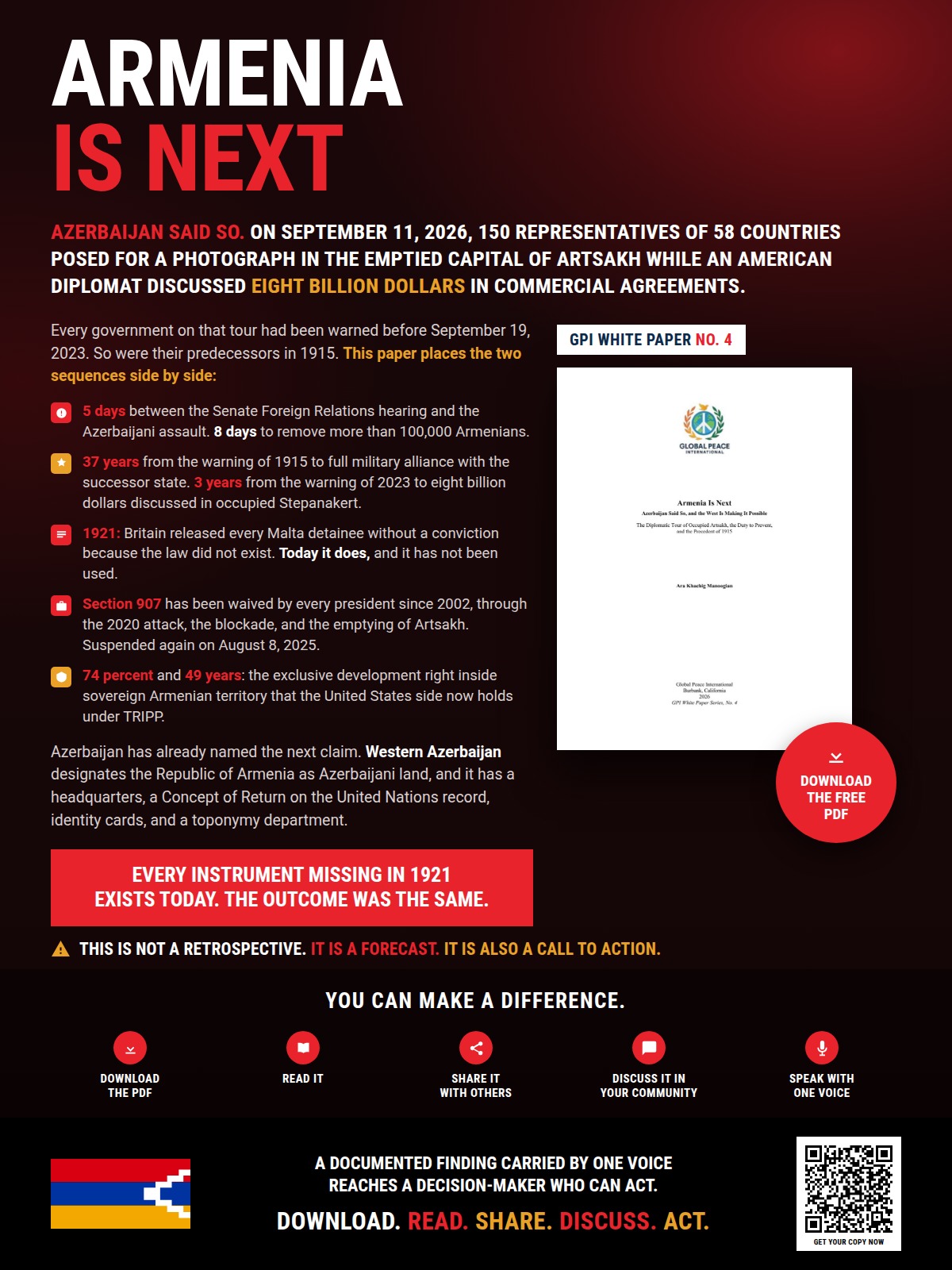
On September 11 and 12, 2026, Azerbaijan drove roughly 150 representatives of 58 countries and nine international organizations into occupied Artsakh, assembled them in front of a Victory Arch in the emptied capital of Stepanakert, and photographed them. The United States chargé d’affaires used the occasion to discuss more than eight billion dollars in commercial agreements, American participation in Azerbaijan’s defense exhibition, and the continued suspension of Section 907. This paper documents what those governments knew before the population was removed, and what they have done since.
Every government represented on that tour had specific notice of a serious risk of genocide before September 19, 2023: a ten-month obstruction of the Lachin corridor affecting 120,000 people, a binding order of the International Court of Justice on February 22, 2023, a genocide opinion issued on August 7, 2023 by a former Prosecutor of the International Criminal Court, and the presentation of that opinion to a commission of the United States Congress on September 6. Azerbaijan attacked five days after the Senate hearing that followed, and more than 100,000 Armenians were gone within eight days. The paper sets that record beside the sequence that began in 1915, when the same powers declared they would hold the Ottoman leadership personally responsible, then released every Malta detainee without a conviction, discarded the Wilson award, concluded Lausanne with no Armenian party to it, and arrived at full military alliance with the successor state thirty-seven years later. From the warning of 2023 to eight billion dollars discussed on the ground in occupied Stepanakert took three. It documents the arming of the perpetrator in both sequences, from the July 1915 Spanish Mauser arrangement recorded in the Colt archive at the University of Rochester to the 1992 appearance of Iran-Contra figures in Baku under the MEGA Oil name, and the unbroken run of Section 907 waivers from 2002 to the suspension signed on August 8, 2025. It assesses the Trump Route for International Peace and Prosperity as a forty-nine-year exclusive development right inside sovereign Armenian territory, held through a company in which the United States side takes 74 percent. And it documents the claim Azerbaijan has already announced: the Western Azerbaijan doctrine, which designates the Republic of Armenia as Azerbaijani land and now has a headquarters in Baku, a Concept of Return lodged on the United Nations record, identity cards, and a toponymy department. Every legal instrument that was missing in 1921 exists today. The outcome was the same. Read the paper, and understand what is being prepared.

Since September 2023 Armenians have been told, in more or less polite language, that Artsakh is finished and that the practical course now is to stop asking. This paper sets out why that is wrong as a matter of law, and it does so using documents that are not Armenian in origin: London Stock Exchange filings, court judgments, and Azerbaijan’s own instruments.
In 1997 Azerbaijan sold mineral rights over territory it did not control, on a contract that would reset to year zero the day the government declared the ground safe. The population was expelled in September 2023. The mine was commissioned in July 2025 and generated 71.4 million dollars in the first six months of 2026. This paper documents the sequence, establishes why the extraction is pillage under the Rome Statute, names the companies, states, and individuals profiting from the emptying, and sets out the order of remedies in which return comes first and compensation covers only what return cannot repair. It also carries proof that the method works: on 1 August 2026, five days after a documented finding was published and Armenian organizations on six continents said the same thing at the same time, Marriott International withdrew a tour selling access to occupied Artsakh. No court, no government, no resolution. Read the paper, keep the file open, and be ready to speak with one voice.

For more than fifty years, Armenians have been asked to celebrate resolutions, committee votes, and proclamations from Washington as victories. This paper documents what those measures actually produced — and makes the case for moving from symbolic statements to binding law.
The work did not end with Operation Nemesis. From the Tehlirian trial to Raphael Lemkin to binding international genocide law, the responsibility has passed into a different arena — and the 1,000 Book Initiative is its measurable expression today: the documented Armenian case, placed directly into congressional offices, one briefing package, one enforceable law at a time. Read the paper, understand the record, and stand with us.

How "Western Azerbaijan" moved from rhetoric to official state policy — and what that means for Armenian sovereignty after the 2023 depopulation of Artsakh.
This paper is the companion to the full-length study Western Azerbaijan: The Next Stage After Artsakh. Read it free on our Patreon, then explore the complete book in our bookstore.
We are converting and publishing additional white papers from our research archive. Follow us on Patreon to be the first to read each new release.