
Independent national-security risk assessments. Each one takes a single project or policy, tests it against the security environment as it actually stands rather than an assumed peace, and states the finding plainly. Read the latest below.
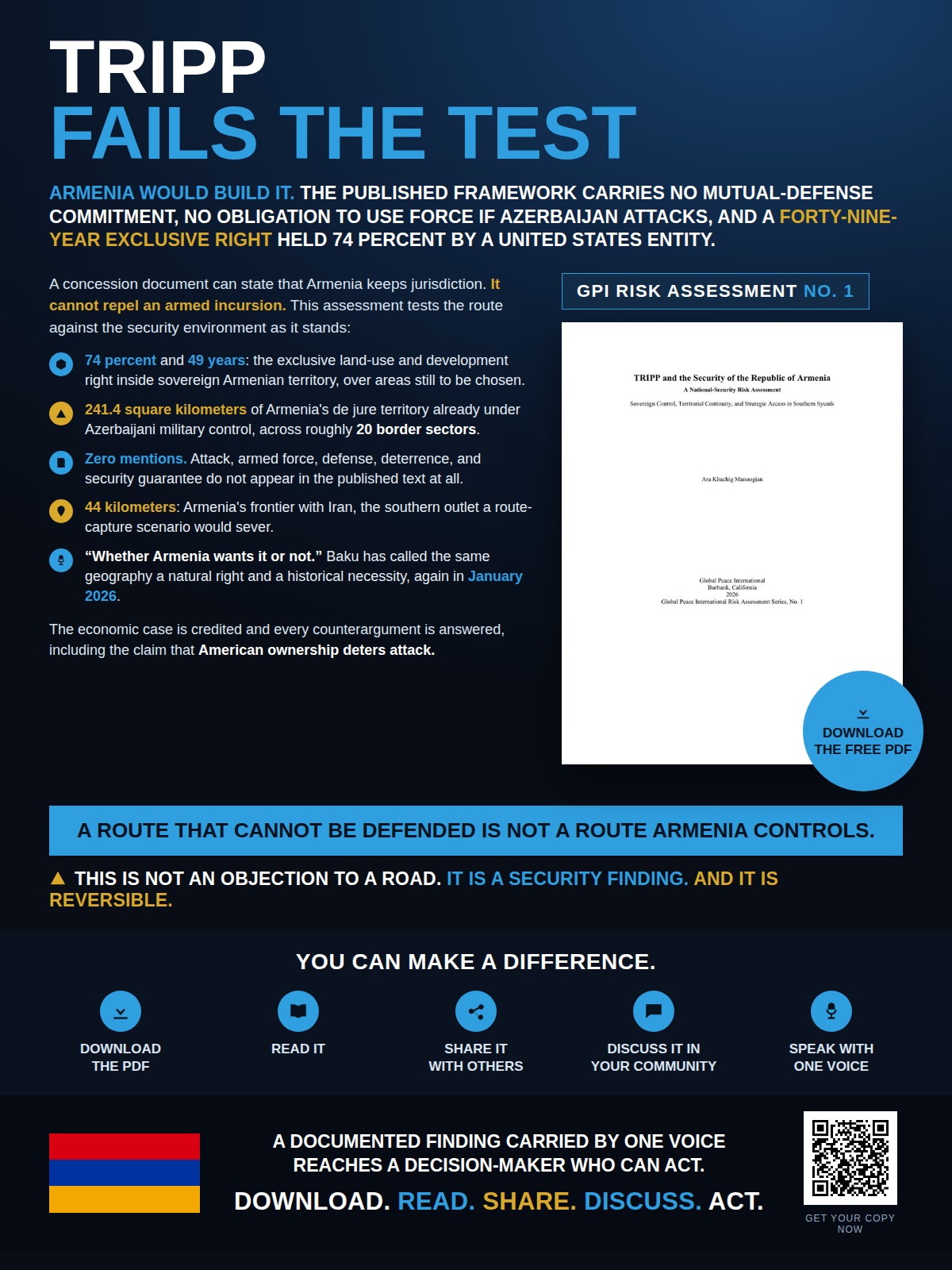
The Trump Route for International Peace and Prosperity is presented as a peace and connectivity project: unimpeded transit across Armenian territory, a link between mainland Azerbaijan and the Nakhchivan Autonomous Republic, and Armenian integration into a wider Trans-Caspian trade network. This assessment tests it against the question the published documents do not answer. What prevents a sovereign Armenian transport route from being converted by force, coercion, or a fait accompli into a route Armenia no longer controls?
The published framework contemplates a joint development company in which a United States entity holds a 74 percent controlling stake and Armenia 26 percent, with exclusive land-use and development rights for an initial forty-nine-year term over implementation areas to be selected later. It affirms Armenian sovereignty, jurisdiction, customs authority, law enforcement, and emergency primacy, and those provisions are real. A word-by-word review of the same text finds no mutual-defense commitment, no automatic obligation to use force if Azerbaijan attacks Armenian territory, and no mechanism comparable to a collective-defense guarantee. The words attack, armed force, defense, deterrence, and security guarantee do not appear in it at all.
The report sets that omission beside the environment as it stands. Open-source mapping published in October 2025 placed at least 241.4 square kilometers of Armenia's de jure sovereign territory under Azerbaijani military control across roughly twenty border sectors. The route's strategic center is Syunik, the narrow southern band that carries Armenia's 44-kilometer frontier with Iran. Azerbaijan's president has called the same geography a natural right and a historical necessity and has said it will open whether Armenia wants it or not. The assessment credits the economic case and takes each counterargument on its merits, including the argument that American ownership deters attack. It traces the participant network and the flow of funds, the minerals the route would carry, and the rail concession Armenia has not resolved, then sets out conditions precedent, a full alternatives analysis, and recommendations to Armenia, to the United States, to the project's contractors and financiers, and to regional stakeholders including Iran.
The finding is that under present conditions TRIPP fails the national-security test applied here. The failure does not arise because the road or the railway cannot be built. It arises because the project creates a high-consequence strategic asset in the most sensitive part of Armenia before the underlying military and territorial dispute has been durably resolved, while the published architecture supplies commercial governance and peacetime border management and no explicit external defense guarantee sufficient to neutralize the route-capture scenario.
The Risk Assessment Series applies one standard to any actor, project, or policy that would change conditions on Armenian ground. Further reports are in preparation and will be posted here as they are released.